Wednesday, October 24, 2007
GAME 1. I was hoping to get a look at what the Rockies can do. It's the 5th inning and I still don't think I've seen it. But you can't tell much about any team when a.) Josh Beckett is pitching well and b.) they're getting the holy shit kicked out of them. Every Red Sox batter has plated a run. I think Hurdle left Morales and Speier in as long as he did because he figures the game is lost and he just wants them to get a full load of what they're facing in this Series.

SERENDIPITY. The website for Joshua Wolf Shenk's Lincoln's Melancholy makes the book look interesting to me -- especially since I spotted this:
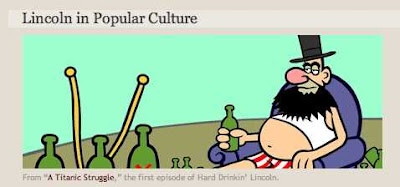
Yes, it's Simpsons producer Mike Reiss' "Hard Drinkin' Lincoln" in a serious intellectual context. Shenk's link is outdated, but you can view several episodes here. You have to watch ads, but it's worth it. It's one of those rare entertainments in which the execution matches the glorious poor taste of the premise. "The Un-Civil War," in which Lincoln greets Robert E. Lee at Appomattox with "LOOOOOOO-ser!" is not to be missed, and includes my favorite alternate version of "Dixie."

Yes, it's Simpsons producer Mike Reiss' "Hard Drinkin' Lincoln" in a serious intellectual context. Shenk's link is outdated, but you can view several episodes here. You have to watch ads, but it's worth it. It's one of those rare entertainments in which the execution matches the glorious poor taste of the premise. "The Un-Civil War," in which Lincoln greets Robert E. Lee at Appomattox with "LOOOOOOO-ser!" is not to be missed, and includes my favorite alternate version of "Dixie."
A REAL PRIZE. National Review's Jonah Goldberg is honored to be considered for the International Policy Network's Bastiat Prize. Here's what the Prize honors:
Limited government:
IPN's Bastiat Prize for Journalism was inspired by the 19th-century French philosopher and journalist Frédéric Bastiat. The prize was developed to encourage and reward writers whose published works eloquently and wittily elucidate the institutions of a free society: limited government, rule of law brokered by an independent judiciary, protection of private property, free markets, free speech, and sound science.Let's do a checklist.
Limited government:
[on domestic spying] Yes, yes, "slippery slopes" and all that. Gotcha. What else do you have? Because that isn't enough. If you go looking for slippery slopes, you'll always find them. That doesn't mean they're really there. The Patriot Act was called a banana peel on the path to hell, and yet it has turned out to be very difficult even to keep it alive. (See also, "I would prefer as small a government as most anti-state conservatives, but it seems to me the first order of business in a demolition job is to clear out the occupants, and that means kicking the Left to the curb. Once they're gone, we can turn the lights off," etc.)Rule of law brokered by an independent judiciary:
It's almost impossible to think of a major area of life in America where a judge somewhere hasn't ruled in flagrant defiance of the democratic will of the people as expressed in a referendum or through the state legislature.Protection of private property:
Sure, the destruction of Iraqi property may not be good for the Iraqi economy in the strict broken-window sense the paleo-libertoids keep invoking. But when you think of Iraq as being controlled by a crime syndicate, things become much clearer. Destroying this syndicate-a.k.a. "regime change" — is an effort at unlocking hidden capital.Free markets:
We can talk more about libertarian schisms another day, but the fact is that many of the libertarian proponents of legalization either want more people to do drugs or simply don't care if they do.Free speech:
I've said it before and I'll say it again: I'm in favor of censorship...Sound science:
Chesterton's observation that the purely rational man will not marry is just as correct today, because science has done far more damage to the ideal of love than it has done to the notion of an awesome God beyond our ken.Given that he is equally qualified on the "wittily" stipulation, Goldberg should win in a walk. Next, he should look into the Guinness Book of World Records' standards for Cheetos consumption.
Tuesday, October 23, 2007
 THE LAST TIME THE METEORS CAME, WE THOUGHT THE SKY WAS ON FIRE. NATURALLY WE BLAMED THE IRISH. WE HANGED MORE THAN A FEW. And you think I'm an old crank! Megan McArdle contra whippersnappers Brian Beutler and Ezra Klein:
First of all, the notion that this is some sort of uniquely horrible moment in world history is absurd. I grew up with the very real fear that one day, without much warning, I would simply vanish in a radioactive cloud. The fear of nuclear annihilation was the ever-present undercurrent to the lives of children living in major urban areas, or near military installations, in a way that you simply cannot comprehend unless you've lived it. Compared to the threat of global thermonuclear war, any of the world's current problems, including climate change, are trivial.'Course folks were tougher in those days. I was jitterbuggin' that very night. And we had the liberals and commies to deal with, too:
Think of the communists languishing for decades, their only substantial achievement stealing nuclear secrets for Stalin. Or the student movement of the 1960's which contributed to the end of the war, but lost on everything else they wanted, and moreover only fought against the war because half of them thought Ho Chi Minh was the good guy.Us libertarians showed 'em, though:
Or the decades it took for the NAACP et. al. to get America to the point where we could even have a civil rights movement.How'd them liberals feel when the Invisible Hand wrote Brown vs. Board of Education and the Civil Rights Act? Pretty darned foolish, that's what!
What any of this has to do with what Klein and Beutler wrote is hard to figure. They seem to be saying that it's hard to gain much these days with old-fashioned protest tactics such as marches. At the end of her lecture, McArdle does appear to relate to their arguments:
The narrative where you pour out of the classroom, tell everyone how wrong they are, and sit back and wait for magic social change is a fantasy cooked up by the Baby Boomers. Who, by the way, destroyed the effectiveness of protest by creating a protest culture which emphasized alienation from, rather than solidarity with, the larger culture.In other words, she agrees that old-school protest is pretty weak, but thinks Klein and Beutler are forgetting the real problem: fogeys even fogeyer than Megan McArdle.
Funny, from her writing I thought she was about 19.
UPDATE. McArdle responds to Beutler:
I *do* think that protest has become less effective, but that's largely because protest only was effective when the protesters dressed and acted like solidly middle class members of the larger society. The shiite protesters I watched at the Saudi embassy the other day understood that--*they* were all in suits. But most protests today involve a substantial number of protesters whose idea of dressing for the protest involves shining their Che tattoos. The message this sends is: this is an issue that fringe nut jobs care about.Presumably she's okay with Billionaires for Bush.
CREDIT WHERE CREDIT IS DUE. The Wall Street Journal and Jonah Goldberg mourn the anniversary of Robert Bork's rejection as a Supreme Court nominee. Among the non-participants: Glenn Harlan Reynolds --
In case you think Bork might have mellowed over the years, here's something he wrote in 2005:
...I also think that Bork was an unsuitable nominee who deserved to be rejected. And I say this as someone who is, in fact, more of an originalist than Bork, whose originalism was of a rather dubious and frequently uninformed nature. This is given away in a passage of [Journal writer] McDowell's, where he writes:I'm not a big fan of the Ole Perfesser, but I think that was well-said.In his sober constitutional jurisprudence there was no room for any airy talk about a general right of privacy, allegedly unwritten constitutions, vague notions of unenumerated rights, or what the progressive Justice Black once derided as "any mysterious and uncertain natural law concept." For Mr. Bork, the framers said what they meant, and meant what they said.Well, actually, here's what the Framers said about unenumerated rights:The enumeration in the Constitution, of certain rights, shall not be construed to deny or disparage others retained by the people.Denying and disparaging is pretty much what Bork did, especially with his famous characterization of the ninth amendment as an "inkblot."
In case you think Bork might have mellowed over the years, here's something he wrote in 2005:
Contrast Tocqueville with Justices Harry Blackmun and Anthony Kennedy. Justice Blackmun wanted to create a constitutional right to homosexual sodomy because of the asserted " 'moral fact' that a person belongs to himself and not others nor to society as a whole." Justice Kennedy, writing for six justices, did invent that right, declaring that "at the heart of [constitutional] liberty is the right to define one's own concept of existence, of meaning, of the universe, and of the mystery of human life." Neither of these vaporings has the remotest basis in the actual Constitution, and neither has any definable meaning other than that a common morality may not be sustained by law if a majority of justices prefer that each individual follow his own desires.In the words of another commentator whom I have quoted with approval but infrequently: Ngnnngnnyahh. Remind me to buy Ted Kennedy a drink.
SPORTING NEWS. Scott Lemieux tipped me to this wonderful article about Mets '86 alum Wally Backman, whose case has been considered here before. Here's a highlight from his minor league managerial career:
"Mike," Backman said, according to witnesses, "if you ever call me an embarrassment again, I will kick your f------ ass!"The Mets should immediately fire Willie Randolph and hire Backman. For serious.
"But Wally," Janela said, "22 bats …"
"I don't care if it was 100 f------ bats!" Backman said. "If you do that one more time I will shove your mike up your ass!"
SHORTER JAMES LILEKS: Letters from Iwo Jima was one of the best war movies I’ve ever seen, which I will now denounce.
NO GUARDRAILS. Today's crackpot statement:
Ladies and Gentlemen, Ole Perfesser Instapundit:
This spin-zone response is understandable, and not only in terms of abnormal psychology. In modern politics, the rule is: attack, never defend. It has worked well a good long time, and it may work a while longer.
But in our current, lunatic discourse, this approach may have reached a point of diminishing returns. If you continually support and enable the crazy things your mouthpieces emit, they have no incentive to tone it down. They'll just keep getting crazier. And ordinary people who aren't part of the million-man rugby scrum of bare-knuckle politics won't take into account your perceived necessity to defend their indefensible statements: they'll just assume that you're crazy, too.
Tell a guy who isn't particularly political what Glenn Beck said. I doubt he'll think, oh, this is just more liberal battlespace preparation, whatever the fuck that is. He'll probably think Glenn Beck is crazy. He doesn't need Media Matters to tell him that.
You have to remember that next to nobody reads our stupid blogs or listens to our stupid podcasts and watches our stupid vlogs. Our framings and formulations are intramural sport on the junior varsity level. What people might read or see or hear is a credentialed buffoon like Glenn Beck, who is probably very happy to hear that somebody in the "new media" supports his bullshit and may thus feel empowered -- fuck the advertisers! the real people get me! -- to step it up.
That suits me; I feast on this nonsense. But I'm not trying to get anyone elected. In the immortal words of Albert Brooks, I'm a comedian, not a liar; I can afford the luxury of honesty.
On the October 22 edition of his nationally syndicated radio program, host Glenn Beck stated, "I think there is a handful of people who hate America. Unfortunately for them, a lot of them are losing their homes in a forest fire today." Beck continued: "There are a few people that hate America. But I don't think the Democrats are those. I think there are those posing as Democrats that are like that." Beck's comment came as forest fires ravaged parts of Southern California, leaving one person dead, four firefighters wounded, and forcing about 1,500 people from their homes, according to The New York Times.You might think Responsible Conservatives would either ignore this or give it the Coulter's-gone-too-far treatment. That's pre-October 22 thinking, buddy:
It's Beck's opinion that some who hate America live in that area.Just some nut, right? Like this one, right? Surely the Serious People among them will go another way.
Is this even debatable?
These Clinton stooges forfeited all credibility in their most recent smearing of Rush Limbaugh.
Apparently, these Stalinist punks have a hitlist they're working through, so this week, it's Glenn Beck. I'm sure he's quaking in his shoes.
Ladies and Gentlemen, Ole Perfesser Instapundit:
MORE BATTLESPACE PREPARATION EFFORTS from the MediaMatters crowd. So far it hasn't been working very well for them, but they haven't quit trying.To recap, conservative guy says something insane; conservative response is that liberals are just trying to make them looking bad by telling people what the conservative guy said.
This spin-zone response is understandable, and not only in terms of abnormal psychology. In modern politics, the rule is: attack, never defend. It has worked well a good long time, and it may work a while longer.
But in our current, lunatic discourse, this approach may have reached a point of diminishing returns. If you continually support and enable the crazy things your mouthpieces emit, they have no incentive to tone it down. They'll just keep getting crazier. And ordinary people who aren't part of the million-man rugby scrum of bare-knuckle politics won't take into account your perceived necessity to defend their indefensible statements: they'll just assume that you're crazy, too.
Tell a guy who isn't particularly political what Glenn Beck said. I doubt he'll think, oh, this is just more liberal battlespace preparation, whatever the fuck that is. He'll probably think Glenn Beck is crazy. He doesn't need Media Matters to tell him that.
You have to remember that next to nobody reads our stupid blogs or listens to our stupid podcasts and watches our stupid vlogs. Our framings and formulations are intramural sport on the junior varsity level. What people might read or see or hear is a credentialed buffoon like Glenn Beck, who is probably very happy to hear that somebody in the "new media" supports his bullshit and may thus feel empowered -- fuck the advertisers! the real people get me! -- to step it up.
That suits me; I feast on this nonsense. But I'm not trying to get anyone elected. In the immortal words of Albert Brooks, I'm a comedian, not a liar; I can afford the luxury of honesty.
Monday, October 22, 2007
BUT YOU WOULDN'T WANT TO LIVE HERE. I recently allowed myself to dream that a slew of anti-Gotham posts by rightwingers meant New York was losing cachet sufficiently to discourage immigration, which would eventually plunge our City back into bankruptcy and bring about the cheap rents and moral chaos of my youth. Culture warrior S. T. Karnick revives my hope in a review of some TV shows:
Hence it should hardly surprise us that not one but two new shows on the CW this year are based on the premise that life among the wealthy in Manhattan is so bad that even self-imposed exile is better.Hear that, kids? We're fucking miserable! It was all a scam! Flee for your lives! "Sex & The City" -- it's a cookbook!
Interestingly, the point of both shows is that the moral weakness and decadence of the New York wealthy is what makes life there really rather miserable.
WAR SELLS, BUT WHO'S BUYING? Michael Yon offers to let newspapers print his favorable Iraq dispatches for free. He pitches this as a patriotic attempt to provide his otherwise benighted fellow citizens with "work that many commenters say needs to reach a wider audience."
But isn't there already a market for Yon's work? There are the reliably conservative New York Post, Wall Street Journal, Washington Times, Boston Herald, Manchester Union-Leader, Pittsburgh Tribune-Review, et alia; dozens of other papers that supported Bush in 2004; and many other less conservative-identified papers that still publish columns by George Will, Charles Krauthammer, Cal Thomas, and other rightwingers. For many of them, money is not an issue. Hell, Murdoch or Scaife could put Yon in front of millions of readers with a snap of their fingers. And it's not like they don't know him -- in fact some of these papers have covered him, and a few have already published him.
I am sympathetic to any author trying to reach a wider audience, so whether Yon is sincere about his public service, or just trying to draw attention or donations, doesn't matter to me. But to suggest that the press en masse is so insensitive to his work that he has to offer it for free -- and enlist the aid of his blogbrothers to make it so -- frankly defies belief.
But isn't there already a market for Yon's work? There are the reliably conservative New York Post, Wall Street Journal, Washington Times, Boston Herald, Manchester Union-Leader, Pittsburgh Tribune-Review, et alia; dozens of other papers that supported Bush in 2004; and many other less conservative-identified papers that still publish columns by George Will, Charles Krauthammer, Cal Thomas, and other rightwingers. For many of them, money is not an issue. Hell, Murdoch or Scaife could put Yon in front of millions of readers with a snap of their fingers. And it's not like they don't know him -- in fact some of these papers have covered him, and a few have already published him.
I am sympathetic to any author trying to reach a wider audience, so whether Yon is sincere about his public service, or just trying to draw attention or donations, doesn't matter to me. But to suggest that the press en masse is so insensitive to his work that he has to offer it for free -- and enlist the aid of his blogbrothers to make it so -- frankly defies belief.
SHORTER JAMES LILEKS: Why must striplings consume alcohol at college football matches? And so robustious their displays! Deuced near spoiled our family event. But Pater is a stout old fellow. Tomorrow: a report on the treasons of Clint Eastwood!
LOCAL ARTS REPORT. At the New Yorker, James Surowiecki mulls the effect of high rents and prices on the cultural capital of New York, and comes down on the optimistic side:
And "boutiques"? That's a weird but telling inclusion, suggesting that in search of a "rule of three" capstone Surowiecki had to go to the commercial arts, which, as I have suggested, is the predominant mode for arts in the City anymore.
In the arts, as in everything else, New York is heedlessly feeding on its seed corn. Big, bright entertainments swell our coffers, but the cost of living makes it ridiculously hard to launch a dance troupe, a theatre company, or any other group endeavor without a huge investment behind it. We can't keep the balloon aloft indefinitely with prestige productions at the American Airlines Theatre. How long can you expect the ambition of newbies to survive on ancient glamor? How long before the artistic capital flows somewhere else?
Here's a useful counterpoint at Broadway & Me (h/t James Wolcott), about the insane price of Broadway tickets in general and Mel Brooks' Young Frankenstein in particular:
Currid’s desire to subsidize creativity is understandable, but her insistence that the culture industry is on the verge of crisis is refuted by her own work. Unless you think that network effects in the art-and-culture business are suddenly going to stop mattering, creative people are still going to find ways to make a living here, because they must, in order to succeed. And, empirically, if you look at the history of New York in the twentieth century there is little evidence that a more expensive New York is a less creative New York. To be sure, there was a tremendous artistic efflorescence in the nineteen-seventies, the worst decade of the century for the New York economy. But, in the twenties and the sixties, cultural booms coincided with economic ones, while the explosion in the number of art galleries, bands, and boutiques in the past decade makes it hard to believe that New York is suffering from too little art and culture. It’s true that clusters of industry can fade away—think of what happened to Pittsburgh steel. But New York has been a cultural mecca in good times and bad, and until we hear otherwise it seems likely that the pilgrims will just keep coming.I take his points, but "the explosion in the number of art galleries, bands, and boutiques in the past decade" is a little misleading. Certainly there are a lot of galleries, but what's the barrier to entry for young, un-networked artists of the sort who stormed the citadels in the East Village of the 80s? There may be plenty of bands, but the number of entry-level Manhattan clubs seems stuck on repeat, with no physical cluster that I know of evolving into a vital scene.
And "boutiques"? That's a weird but telling inclusion, suggesting that in search of a "rule of three" capstone Surowiecki had to go to the commercial arts, which, as I have suggested, is the predominant mode for arts in the City anymore.
In the arts, as in everything else, New York is heedlessly feeding on its seed corn. Big, bright entertainments swell our coffers, but the cost of living makes it ridiculously hard to launch a dance troupe, a theatre company, or any other group endeavor without a huge investment behind it. We can't keep the balloon aloft indefinitely with prestige productions at the American Airlines Theatre. How long can you expect the ambition of newbies to survive on ancient glamor? How long before the artistic capital flows somewhere else?
Here's a useful counterpoint at Broadway & Me (h/t James Wolcott), about the insane price of Broadway tickets in general and Mel Brooks' Young Frankenstein in particular:
And it's part of an alarming trend that is turning the cultural world of New York into a gated community. As a kid, poor but culture-crazed, I used to stroll into the Met or MOMA on Sunday afternoons and wander their corridors without paying a cent. Those museums now say that you only have to pay what you wish but the big signs over their ticket booths say you should pay $20 and I can't imagine my younger self daring to walk by them. During one spring college break back in the '70s, I saw seven Broadway shows for $100 bucks. If the price of a single ticket back then had been $100, I wouldn't even have thought of going to one show. And that's the problem. Those of us who love theater want everyone, maybe especially poor theater-crazed kids, to think of theater and art and music as something that is for them.
...In his column last week, New York Post columnist Michael Riedel wrote about how [Mel] Brooks had resigned from the Dramatists Guild rather than pay the 3% of his royalties that all members are assessed (click here to read it). When Brooks brought The Producers to Broadway in 2001, he was hailed as its savior, someone who was leading the musical comedy into a new golden era, who was, as a lyric from the show put it, The King of Old Broadway. As my grandma used to say, you've got to be careful what you wish for.
Sunday, October 21, 2007
OKAY -- SO I AIN'T EDUCATED. As Jeff Goldstein is apparently deep into one of those frequent cataleptic trances from which he only emerges to cadge spare change, the Protein Wisdom second stringers try their hand at semioticking. Dan Collins:
Darleen Click seems to think that liberals (also known by our dream name, "schools") are hypocrites because they support birth control for pre-teens but do not support seven-year-olds drawing stick figures with guns. I believe our true position is clear and consistent.
The rest of the page at this writing is completely incomprehensible (which may owe to my lack of grad school training) except for this, which appears to suggest that Randi Rhodes is a fun date.
Frank Rich: Suicide Is Not PainlessThe Frank Rich piece is one of his good ones, in which he reports on U.S. servicemembers who felt badly enough about the Iraq boondoggle in which they were enmeshed to kill themselves. One of them left a long note detailing his unbearable situation. Foster, you may recall, left a note naming the Wall Street Journal nuts who hounded him, and who kept up their hounding even after his death. There is surely some semiotextual dimension to this comparison that I cannot grasp.
Well, at least the Times are speaking to something they know. Of course, such a thing could never have happened [Vince Foster] under an administration as clean as the Clintons’ [Vince Foster].
Darleen Click seems to think that liberals (also known by our dream name, "schools") are hypocrites because they support birth control for pre-teens but do not support seven-year-olds drawing stick figures with guns. I believe our true position is clear and consistent.
The rest of the page at this writing is completely incomprehensible (which may owe to my lack of grad school training) except for this, which appears to suggest that Randi Rhodes is a fun date.
Saturday, October 20, 2007
THE STEYN GAME: EVERYONE'S A WINNER! Mark Steyn has proof that Montreal and great European cities are in a death spiral: the citizens are having a wonderful time.
Thus the readers thank the Lord they don't have any contact with these Sodoms, and the writers get to live, work, and play in them. Everyone's a winner!
John O'Sullivan and I occasionally discussed Montreal, and he observed that a big-city heritage without big-city overcrowding can be very pleasant: You've still got all the art galleries and symphony orchestras and so on. You've got tickets for Pavarotti at the Place des Arts. Curtain up, 7.30pm. So you leave at 7.20, park outside the front steps and stroll in. As John put it, societies in the early stages of decline can be very agreeable - and often more agreeable than societries trying to cope with prosperity and rapid growth.You have to remember that Steyn and his fellow NRO lunatics operate out of, and often vacation in, great cities which are thought by the yokels to whom they peddle this nonsense to be citadels and vice and corruption. Some of these yokels may wonder why Jonah Goldberg, Steyn et alia don't relocate to, or at least spend long weekends in, Fritters, Alabama, and other conservative redoubts. The NROniks couldn't very well tell them that they actually prefer New York or Paris to Fritters, so every now and then they write something like this Goldberg complaint that Burlington, Vermont is full of people who don't like Bush, which presumably spoiled for him the many fine Burlington restaurants through which he no doubt burned a path.
Which brings me to my usual everything-comes-back-to-demography shtick. Precisely because the first stages of decline are so agreeable, it's very hard to accept it as such. Part of the problem in Europe is that, when chaps like yours truly shriek "Run for your lives! The powder keg's about to go up!", etc, the bon vivant enjoying his Dubonnet at the sidewalk cafe thinks: Are you crazy? Life's never been better. Civilized decline can be so charming you don't notice it's about to accelerate into uncivilized decline.
Thus the readers thank the Lord they don't have any contact with these Sodoms, and the writers get to live, work, and play in them. Everyone's a winner!
COME-TO-JESUS MOMENT. Giuliani apparently got through the Value Voters Summit unscathed. His boldest move was to associate tolerance with Jesus Christ ("Christianity is all about inclusiveness. It’s built around the most profound act of love in human history, isn’t it?"), but he made sure to give zero-tolerance its due: he announced to cheers that he had removed pornography from Times Square, and agreed with them that their "values are under assault by a culture that is moving in the wrong direction.” He also pointed out that the New York Times hates him, and that people "stared" at him when he made the sign of the cross at NYU Law School. Having the right enemies is as important to this crowd as anything else.
He may have this thing finessed. His Texas operative, Governor Rick Perry, is telling the folks back home that Giuliani will pack the Supreme Court to overturn Roe v. Wade, and Tony Perkins of the Family Research Council has announced that Giuliani will support a constitutional amendment banning gay marriage. That the candidate himself is more muted on these issues may not matter to evangelical leaders. They know he'll do anything for power, and as they consider themselves an important force in the Party, they may internalize the obvious message: you scratch my back and I'll scratch yours. Out in the holler, Cletus and Brandine may not get it, but once the word goes out among the preachers and the ward-heelers, they can be brought into line.
He may have this thing finessed. His Texas operative, Governor Rick Perry, is telling the folks back home that Giuliani will pack the Supreme Court to overturn Roe v. Wade, and Tony Perkins of the Family Research Council has announced that Giuliani will support a constitutional amendment banning gay marriage. That the candidate himself is more muted on these issues may not matter to evangelical leaders. They know he'll do anything for power, and as they consider themselves an important force in the Party, they may internalize the obvious message: you scratch my back and I'll scratch yours. Out in the holler, Cletus and Brandine may not get it, but once the word goes out among the preachers and the ward-heelers, they can be brought into line.
END OF THE LINE. Dean Esmay* spreads the good news: electricity up in Iraq --
Don't be so sure. Iraq gets nine percent of its juice from Turkey -- whose power people indicate they will cut the flow if their government sends troops into Northern Iraq to fight Kurdish terrorists. Still, not to worry -- more electricity is coming via business interests headquartered with our traditional allies, China and Iran.
U.S. authorities still speculate Baghdad will have full power by 2013. This hardly seems an educated guess, given that the presumed sources of energy are as jerry-rigged as the city's private generators.
Meanwhile it seems Iraq's best power consumers are getting all they need, as war fan Matt Sanchez reports:
*UPDATE. By which I of course mean Dave Price by way of Dean Esmay -- thanks to Martin Wisse for the clarification.
Little noticed this month was the news that Iraq's electricity production has set a new all-time high in September of around 6,860 MW, including 2,000 MW or more of non-public generation (p40), illegal under Saddam (because like any good national socialist despot, he outlawed private generators). Oil revenue also set a new record of $3.79 billion (p39).Sounds like paradise. Of course, it's a matter of perspective -- the Detroit Free Press reports:
Four and a half years after the U.S.-led invasion of Iraq, it's never certain when the power will arrive, just that one electrified hour will come in the morning, another at night. U.S. reconstruction officials say that on average, electricity is available 10 hours a day, but Akhbal, 48, doesn't know anyone who gets close to that much.Well, private generators, that's good, right? Magic of the market and all that, especially compared to Saddam's socialist power plan. The Iraq authorities intend to privatize everything, and that will lead to Vegas-bright lights to Mesopotamia soon enough.
Before the war, Baghdad residents got 16 to 24 hours of power a day, according to the Brookings Institution, a Washington research center. Brookings said that in September residents got 7.6 hours...
City blocks often have two or three small operators running generators that power dozens of homes and shops for a few hours a day. Hundreds of multicolored wires from the generators to customers are lashed haphazardly to every available pole and sometimes even trees.
Don't be so sure. Iraq gets nine percent of its juice from Turkey -- whose power people indicate they will cut the flow if their government sends troops into Northern Iraq to fight Kurdish terrorists. Still, not to worry -- more electricity is coming via business interests headquartered with our traditional allies, China and Iran.
U.S. authorities still speculate Baghdad will have full power by 2013. This hardly seems an educated guess, given that the presumed sources of energy are as jerry-rigged as the city's private generators.
Meanwhile it seems Iraq's best power consumers are getting all they need, as war fan Matt Sanchez reports:
FOB Sedgwick, in the middle of nowhere and not far from the Syrian border, had running water, electricity, a gym, air-conditioned housing and enough bandwidth to run an encrypted computer network and phone system.Our troops, I assert patriotically, deserve all this and more. I do spare a thought for the locals, though, who seem to be at the end of a very long line for basic services.
*UPDATE. By which I of course mean Dave Price by way of Dean Esmay -- thanks to Martin Wisse for the clarification.
Friday, October 19, 2007
COLD SHOWERS FOR EVERYBODY! It's Friday -- and at National Review Online, you know what that means: time for sex hatred! The surprising dud in the bunch is Jonah Goldberg, who emits one of those No Guardrails thumbsuckers about how Madonna and Pamela Anderson (!) are turning girls into prostitutes with the help of the Democratic Party. He even writes "What matters is the signal such people send." As usual with Goldberg, this is the stupidest thing ever written, and will remain so until Goldberg writes something else.
The hapless K.-Lo. fares little better, submitting what seems to be a synopsis of a botched interview -- maybe the Margarita Hut had a generous buy-back policy -- with the authoress of a book called Girl Gone Mild: Fashionably Long, Overexplanatory Subtitle. From the precis, we may judge that insofar as the book has a point (besides serving as a rightwing front-group party favor), it is that some young women will not wear thongs, dammit, despite what Harry Reid and Nancy Pelosi may think. "Today, more and more sensible young women are bridling when they hear 'bitches' and 'hos' on the radio," she writes. Very good! How do they react when they hear "bear my baby whether you want to or not, subhuman?"
As often happens in these dimwit competitions, the prize goes to a newbie: legacy pledge Ryan T. Anderson, "an assistant editor at First Things," who says that a skit the Princeton frosh are required to attend "amounts to little more than mandated indoctrination in liberal sexual ideology." Anderson fails to describe the "Sex on a Saturday Night" sketch, so I had to go read another rightwing kid's review, and even through that cloudy prism could see that the skit is a typical bit of agitprop telling the youngsters that date rape is bad. Does Anderson have a different POV? No, he says:
Anderson spends the rest of the article complaining that liberals make jokes about him and his buddies. Normal people learn to shrug this kind of thing off, but for wingers snide comments are hate-speech or bad-touch or something. "Professor [Lee] Silver’s attack wasn’t really aimed at Professor [Robert George]; it was aimed at the students," Anderson claims, because a laff on a prominent conservative buffoon sends students "a message about which points of view are acceptable and which are unacceptable."
One always hears this from young conservatives who were subjected to just such allegedly soul-crushing mockery (Anderson is a Princeton grad), yet somehow managed to retain their contrary opinions into adulthood. How did Anderson do it? Maybe he passed long nights POW-style in his dormitory cell, scratching "God and Man at Yale" on the wall with a piece of purloined charcoal. In any case, is it true the overwhelming majority of students helplessly adopt every piece of nonsense their professors put in their heads? Because if so, I'm going back to college, and looking for a teaching job at an all-girls' school.
The hapless K.-Lo. fares little better, submitting what seems to be a synopsis of a botched interview -- maybe the Margarita Hut had a generous buy-back policy -- with the authoress of a book called Girl Gone Mild: Fashionably Long, Overexplanatory Subtitle. From the precis, we may judge that insofar as the book has a point (besides serving as a rightwing front-group party favor), it is that some young women will not wear thongs, dammit, despite what Harry Reid and Nancy Pelosi may think. "Today, more and more sensible young women are bridling when they hear 'bitches' and 'hos' on the radio," she writes. Very good! How do they react when they hear "bear my baby whether you want to or not, subhuman?"
As often happens in these dimwit competitions, the prize goes to a newbie: legacy pledge Ryan T. Anderson, "an assistant editor at First Things," who says that a skit the Princeton frosh are required to attend "amounts to little more than mandated indoctrination in liberal sexual ideology." Anderson fails to describe the "Sex on a Saturday Night" sketch, so I had to go read another rightwing kid's review, and even through that cloudy prism could see that the skit is a typical bit of agitprop telling the youngsters that date rape is bad. Does Anderson have a different POV? No, he says:
You can tell incoming freshmen that date-rape and other sexual assaults are illegal without subjecting them to an hour of sexual skits, innuendo, “coming-out” scenes, gay kisses, and other nonsense that some students don’t want to be forced to sit through.I hear ya, kid. Similarly, Crest toothpaste didn't have to sell its product by putting commercials on "Will & Grace." They could have just told people how darned good for them Crest was. Turns out people prefer their selling messages to come with racy humor. Who knew?
Anderson spends the rest of the article complaining that liberals make jokes about him and his buddies. Normal people learn to shrug this kind of thing off, but for wingers snide comments are hate-speech or bad-touch or something. "Professor [Lee] Silver’s attack wasn’t really aimed at Professor [Robert George]; it was aimed at the students," Anderson claims, because a laff on a prominent conservative buffoon sends students "a message about which points of view are acceptable and which are unacceptable."
One always hears this from young conservatives who were subjected to just such allegedly soul-crushing mockery (Anderson is a Princeton grad), yet somehow managed to retain their contrary opinions into adulthood. How did Anderson do it? Maybe he passed long nights POW-style in his dormitory cell, scratching "God and Man at Yale" on the wall with a piece of purloined charcoal. In any case, is it true the overwhelming majority of students helplessly adopt every piece of nonsense their professors put in their heads? Because if so, I'm going back to college, and looking for a teaching job at an all-girls' school.
Thursday, October 18, 2007
BEYOND DEMOCRACY. Umpteen-Star General Ralph "Blood 'n' Guts" Peters tells us Pakistan proves that most military coups are A-OK, especially as compared to the vile alternative, democracy.
Aficionados of the General's prose will appreciate his opening:
Feeling his point made, the General ends with a grand speculative leap:
I do hope the General will revisit the subject now that Bhutto's return has inspired a deadly public attack. Amateurs! he must be thinking. A few well-trained snipers could have done the job much better.
Aficionados of the General's prose will appreciate his opening:
WE simplify the problems of others. It's bad enough when we do it to family and friends, but it can be fatal when we simplify the problems of the developing world."Bad enough" to simplify the problems of family and friends! We're in for some very tough love.
The generally accepted line is that all civilian leaders are good, while military coups are always bad. Like most such generalities, it's often wrong.We and the General have come a long way since he likened the newly-democratized citizens of Iraq to a "kid" who had to "ride the damned bike" of democracy "and fall down a couple of times" without too much U.S. interference, lest we become an "overly protective parent." Now the citizens of Pakistan, who saw a great deal more of the bike before Musharraf put it away than have the Iraqis, cannot even be allowed the presence in their government of a former elected leader. For one thing, she has too much "charisma":
Our prejudice is on display again as Benazir Bhutto, a feudal landlord posing as a democrat, returns to Pakistan.
In the West, Bhutto is popular because she's a civilian - and that's about it. Her champions merrily overlook the pestilential corruption, social polarization and pandering to extremists that marked her two terms as prime minister.
Charisma will always be with us. It's human nature to be drawn to a dramatic speaker who struts artfully upon the political stage, telling us that all of our problems are the fault of others and that, if he receives our vote, we'll all soon live in paradise.To be fair, the General is prepared to let politicians strut, if not caper nor gambol, in the U.S., where "checks and balances... restrain the worst men who reach the White House." And he is willing to admit that "Most coup-makers then botch the job of governing," but adds, "just as the civilians they overthrew failed before them," in case we were warming toward the idea of elective representation.
Feeling his point made, the General ends with a grand speculative leap:
Given the inability of non-Western societies to build effective government institutions, it may be time to rethink our faith in the state itself as the answer to their needs.I can't wait for the follow-up. What will replace the state? Surely not the United Nations. Maybe Blackwater, but the General hates them. I guess that leaves space aliens or, more likely, an international brotherhood of military dictators who will erase all meaningless boundaries and continent-hop with arms and instruments of torture, ready to do the business of pacification that feeble politicians messed up in that poorly-remembered age when democracy was thought to be on the march.
I do hope the General will revisit the subject now that Bhutto's return has inspired a deadly public attack. Amateurs! he must be thinking. A few well-trained snipers could have done the job much better.
Subscribe to:
Comments (Atom)